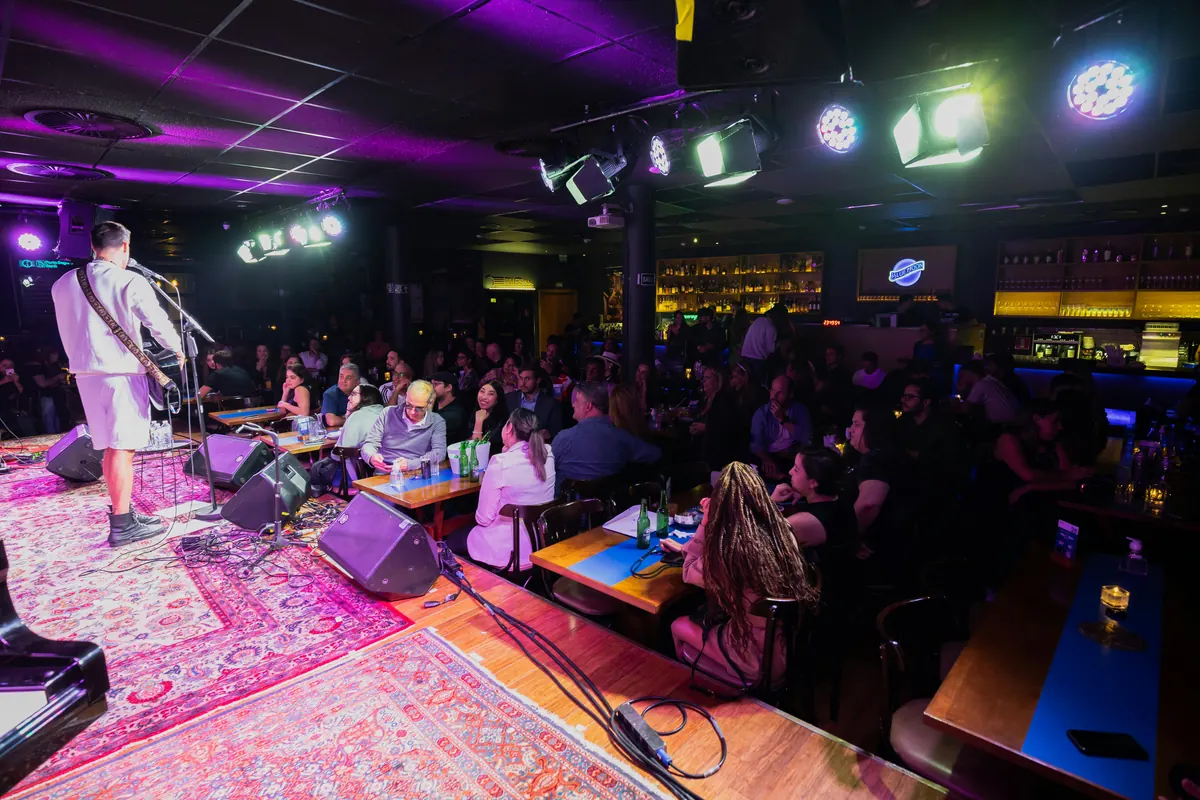
Acoustic cover songs for solo and duo pub gigs, grouped by job in the night: openers, singalongs, Irish pub staples and closers, plus keys, sets and royalties.
A pub gig is not a concert. People are talking, ordering, watching the match on mute and deciding whether to stay for another. The job of a solo or duo acoustic act is to read that room and give it what it needs at each point in the night: something familiar while people settle, something they can sing once the drinks land, and something to send them home happy.
This thread gives you working lists of acoustic cover songs grouped by the job each song does, from openers to late-night closers, Irish pub staples and songs that cross language barriers in hotels and bars abroad. The choices are curation from the circuit, not chart data. Pick what suits your voice and your rooms, then use the sections on set lengths, keys, learning and royalties to turn a list into a night.
How to use these lists
Every song below is chosen for one reason: it does a particular job well with one or two voices and an acoustic guitar. None of these lists claims to rank songs by popularity. A song that fills a Dublin bar on a Saturday might die on a Tuesday in a Bangkok hotel lobby. Treat each table as a pool to draw from.
Some UK solo players publish their own working lists, and they overlap heavily with ours, which tells you something about what a pub room responds to. Surrey-based acoustic act Aaron Norton, for example, lists songs such as Wonderwall, Stand By Me and Brown Eyed Girl as his reliable core. Use lists like these to check your gaps, then build your own from what lands in your rooms.
How many songs to carry, how to rotate them and how to plan a full repertoire is covered in our pub setlist thread. This thread stays with the songs themselves.
Openers: songs that settle a room
The first 20 minutes are about being liked, not being loud. Choose mid-tempo songs people know within two bars, that sit well under conversation and do not ask anything of the audience yet.
| Song | Original artist | Why it works |
|---|---|---|
| Brown Eyed Girl | Van Morrison | Instantly known, happy, and easy to play at a low volume |
| Shotgun | George Ezra | Recent enough for younger drinkers, simple strummed groove |
| Ho Hey | The Lumineers | Built for acoustic guitar; the shouts invite the room in gently |
| I'm Yours | Jason Mraz | Light, swung and friendly under chatter |
| Riptide | Vance Joy | Short, recognisable intro; works on guitar or ukulele |
| Free Fallin' | Tom Petty | Three chords, wide age appeal, easy to sing |
| Take It Easy | Eagles | Rolling strum that suits early evening and older crowds |
| Valerie | The Zutons (best known by Amy Winehouse) | Upbeat without being loud; duos can split the vocal |
Singalongs: the songs the room joins
Once people have a drink and a seat, give them choruses. These are the songs where you can step back from the mic and let the room carry a line. Space them out. Three in a row early in the night uses up your best cards.
| Song | Original artist | Why it works |
|---|---|---|
| Wonderwall | Oasis | Most of a UK or Irish pub knows every word |
| Mr Brightside | The Killers | Big chorus that works even stripped back |
| Sweet Caroline | Neil Diamond | The call and response does the work for you |
| I'm Gonna Be (500 Miles) | The Proclaimers | Simple, loud, and the 'da da da' needs no English |
| Take Me Home, Country Roads | John Denver | Known across generations and continents |
| Wagon Wheel | Old Crow Medicine Show (also Darius Rucker) | Folky groove that fits Irish and country rooms |
| Don't Look Back in Anger | Oasis | Slower singalong; good for a mid-set lift |
| Hey Jude | The Beatles | The long 'na na na' outro can run as long as the room wants |
| Teenage Dirtbag | Wheatus | Thirty-somethings sing it louder than you do |
Irish pub staples
Irish pubs abroad, from Spain to Dubai to Singapore, book acoustic acts partly for atmosphere. Managers often expect a block of Irish songs, especially on match days, St Patrick's week and weekends. You do not need to be Irish to play them, but you do need to play them properly: learn the words, the right tempo and where the room shouts back.
| Song | Original artist | Why it works |
|---|---|---|
| The Wild Rover | Traditional (popularised by The Dubliners) | The 'no, nay, never' claps are a guaranteed lift |
| Whiskey in the Jar | Traditional (The Dubliners; later Thin Lizzy) | Rock fans and folk fans both know it |
| The Irish Rover | Traditional (The Dubliners with The Pogues) | Fast and fun; a good test of your strumming hand |
| The Fields of Athenry | Pete St. John (first popularised by Paddy Reilly) | The big emotional singalong, especially on sports nights |
| Dirty Old Town | Ewan MacColl (The Pogues, The Dubliners) | Mid-tempo, easy chords, much loved |
| Galway Girl | Steve Earle (Irish hit for Mundy and Sharon Shannon) | Lively, and duos with a fiddle or whistle player shine |
| Molly Malone | Traditional | Short, gentle, and everyone knows the chorus |
| Black Velvet Band | Traditional (The Dubliners) | Story song with a chorus the room picks up fast |
| Raglan Road | Patrick Kavanagh poem (sung by Luke Kelly) | For the quieter hour; regulars notice when you know it |
| Seven Drunken Nights | Traditional (The Dubliners) | Comic and interactive; good later in the night |
Dinner hour: slower songs that keep tables happy
Hotels, gastropubs and restaurant bars often book the early hours as background for food. The brief is warm, recognisable and not too loud. These songs also work as a breather between singalong blocks later on.
| Song | Original artist | Why it works |
|---|---|---|
| Can't Help Falling in Love | Elvis Presley | Slow, simple and loved by every age group |
| Stand By Me | Ben E. King | One bass line and four chords; easy to play quietly |
| (Sittin' On) The Dock of the Bay | Otis Redding | Relaxed groove that suits a terrace or a hotel bar |
| Ain't No Sunshine | Bill Withers | Short, moody and great for showing off a voice |
| Fast Car | Tracy Chapman | Fingerpicked pattern that fills space without volume |
| Tennessee Whiskey | Chris Stapleton (first recorded by David Allan Coe) | Slow 6/8 that couples and diners enjoy |
| Make You Feel My Love | Bob Dylan (best known by Adele) | Ballad for a quiet room; popular at hotel gigs |
| Wish You Were Here | Pink Floyd | The intro alone wins over older listeners |
Late-night closers
The last half hour is where tips, rebookings and good reviews come from. Save your strongest singalongs for here, and keep one or two in your pocket for an encore or a 'one more' from the manager.
| Song | Original artist | Why it works |
|---|---|---|
| Don't Stop Believin' | Journey | The last-orders anthem in many rooms |
| Sex on Fire | Kings of Leon | Loud and simple; works with one guitar and a stomp box |
| American Pie | Don McLean | Long, but a packed room will sing the whole thing |
| Twist and Shout | The Top Notes (best known by The Beatles) | Gets people out of their seats |
| Angels | Robbie Williams | The big UK closer for a room full of holidaymakers |
| Maggie May | Rod Stewart | Loose and boozy; perfect after midnight |
| Livin' on a Prayer | Bon Jovi | Key change and all, a room will try |
| Fairytale of New York | The Pogues with Kirsty MacColl | December only, and essential in Irish pubs then |
Songs that work across languages
In hotel lounges, beach bars and Irish pubs across Europe and Asia, much of your audience may not speak English as a first language. Songs with wordless hooks, simple choruses or international film and football fame travel best. Learning one local favourite, even badly, often wins more goodwill than another English hit.
| Song | Original artist | Why it works |
|---|---|---|
| Let It Be | The Beatles | Slow, clear words that most English learners know |
| Hotel California | Eagles | Known worldwide; the guitar line carries the song |
| Zombie | The Cranberries | Big, simple chorus; often requested across Europe |
| Seven Nation Army | The White Stripes | The riff is a football chant, so it needs no lyrics |
| Knockin' on Heaven's Door | Bob Dylan | Two lines to learn, slow and singable |
| Imagine | John Lennon | Widely known, gentle, works in hotel lounges |
| Bella Ciao | Traditional Italian | Known well beyond Italy thanks to TV; check the room first |
| Yellow | Coldplay | Recognised by younger crowds in Asian and European cities |
If you are heading out for a season, check the work rules before you pack. Our threads on Schengen days and work permits, Japan and South Korea entertainer visas, Singapore, Thailand and Vietnam work permits and Dubai live music permits cover the paperwork.
Building sets: 3x45, 2x60 and 4x45
Most pub and hotel bookings come in one of three shapes. At roughly three and a half to four minutes a song, with a little chat between, a 45-minute set holds about 11 to 13 songs and a 60-minute set about 15 or 16. Check your own timings with a stopwatch at home; talkers and long outros change the count.
| Format | Typical room | How to shape it |
|---|---|---|
| 3x45 | UK and Irish pubs, most weekend bar gigs | Set 1 openers and dinner-hour songs. Set 2 builds with singalongs and Irish songs. Set 3 is your strongest material and closers. |
| 2x60 | Restaurants, early hotel slots, Sunday afternoons | Set 1 relaxed and quiet. Set 2 lifts gradually; end on two or three singalongs, not a ballad. |
| 4x45 | Irish pubs abroad, resort bars, long hotel nights | Treat set 1 as background. Sets 2 and 3 carry the singalongs. Keep set 4 flexible for requests and whoever is left. |
- Write down the format in the booking. A 3x45 and a 4x45 are different jobs at different fees. Our performance contract thread covers set times and breaks.
- Plan blocks, not single songs. Group three or four songs of similar energy so you can swap a whole block if the room changes.
- Keep one rescue song per set. If the energy drops, a sure singalong brings it back.
Keys and capo for a solo voice
With no band behind you, your voice is the show. A song in the wrong key costs you more than a missed chord. Two rules cover most cases.
- Singalongs stay close to the original key. If you drop Wonderwall a long way to suit yourself, the room struggles to join in. Move it a little if you must.
- Solo-voice songs go where your voice sounds best. For ballads and dinner-hour songs, nobody is singing with you, so pick the key that makes the highest note of the chorus comfortable at the end of a third set, not the start of the first.
A capo lets you keep familiar open chord shapes while moving the key. Each fret raises the pitch by one semitone. A man singing a song written for a female voice (or the reverse) often needs to move it several semitones, which may mean new shapes rather than just a capo.
| Shapes you play | Capo fret | Sounding key |
|---|---|---|
| G | 2 | A |
| G | 4 | B |
| C | 2 | D |
| C | 5 | F |
| D | 2 | E |
| E | 1 | F |
Note each song's key and capo position in your set list or chart app. At 1am in a dark corner you will not remember whether Fields of Athenry was capo 2 or 3.
Learning songs fast
Circuit work rewards a big, reliable repertoire, and a residency abroad can call for songs you have never played. A simple routine helps.
- Learn the structure first. Write down the sections (verse, chorus, bridge) and the chords for each. Most pub songs reuse two or three patterns.
- Learn the words away from the guitar. Sing along in the car or on a walk until you can recite the lyrics without music.
- Put them together slowly, then play the song three days in a row before it goes in a set.
- Debut new songs early in the night, when the room is forgiving, not in the closing set.
- Keep a tablet or lyric app as backup, but aim to look up at the room, not down at a screen.
A handful of new songs a week, steadily, builds a repertoire faster than cramming before a season.
Handling requests
Requests are part of the job, and a good one played well can turn a table into regulars. Aaron Norton writes that he leaves gaps in his sets for requests on the night. Some practical habits:
- Know your answer for songs you do not play. 'I don't have that one, but how about...' and offer something close in style.
- Do not promise a song you half know. A wrecked request is worse than a polite no.
- Take requests at the right moment. A slow ballad request during the closing set can wait for the next break.
- Check with the manager before playing anything outside the house style, such as rebel songs or explicit lyrics in a family hotel.
Performance royalties: who pays and who collects
Playing covers in a pub raises a question every act asks sooner or later: do I need a licence? In the main English-speaking markets, the answer as of November 2026 is that the venue holds the licence for live music, not the performer.
| Market | Who holds the licence | What performers can do |
|---|---|---|
| UK | The venue, usually through TheMusicLicence from PPL PRS | PRS members report setlists through the PRS Setlist app. Venues and promoters also submit setlists via PPL PRS. |
| Australia and New Zealand | The venue, licensed through APRA AMCOS (OneMusic Australia in Australia) | APRA AMCOS members submit Performance Reports listing originals and any covers played. At promoter-run events the promoter submits. |
| United States | The business, through ASCAP, BMI and other PROs | ASCAP members can submit setlists through ASCAP OnStage for performances at venues ASCAP licenses. |
Royalties follow the songwriter, not the singer. When you play Wonderwall, the money from that performance goes to the people who wrote and publish it. If you are a member of a collecting society and play your own registered songs, reporting your setlist is how you get paid for them.
- PRS for Music: your works must be registered and you must have been a member at the time of the gig. For small venues, PRS says you can claim within a year of the performance; international and large UK shows within three years. At small licensed venues, a fixed royalty is shared between the writers and publishers of everything performed that night.
- APRA AMCOS: a report needs what was played, where and when. Royalties are paid quarterly, in February, May, August and November. The standard claim period is one year from the performance, extendable to three years with evidence.
- ASCAP and BMI: both say US businesses need permission from copyright owners for public performance, including live bands. ASCAP says its members can be paid for performances at any venue it licenses if they submit setlists.
From list to booked nights
A strong cover list is what gets you rebooked. Getting booked in the first place takes a demo, a clear offer and the right contacts. Record a short live medley across these categories for your electronic press kit, then see our guide on how to get gigs as a musician. Hotel and resort work often runs through agents; our thread on finding a music booking agent explains how that works.
When the gigs come in, send a proper invoice each time, and browse the Gig Board or discover venues and agents on Troubadour. For the full picture of building a life on the road, start with our travelling musician overview.
Frequently asked questions
What are good acoustic cover songs for a pub gig?
Pick songs by the job they do in the night: familiar mid-tempo openers such as Brown Eyed Girl, big singalongs such as Wonderwall or Sweet Caroline, slower songs like Stand By Me for dinner hour, and strong closers such as Don't Stop Believin'. Choose ones that suit your voice and your room.
How many songs do I need for a 3-hour pub gig?
At roughly three and a half to four minutes a song, three 45-minute sets need about 33 to 39 songs. Carry extra for requests and for swapping blocks when the room changes. Our pub setlist thread covers how big a working repertoire should be.
What songs should I play in an Irish pub?
Most Irish pubs, at home and abroad, like a block of traditional and Irish songs such as The Wild Rover, Whiskey in the Jar, The Fields of Athenry, Dirty Old Town and Galway Girl, mixed with pop and rock singalongs. Ask the manager before playing rebel songs.
Do I need a licence to play cover songs in a pub?
In the UK, Australia, New Zealand and the US, the venue holds the music licence for live performance, through PPL PRS, APRA AMCOS, or ASCAP and BMI. Performers do not usually buy a licence to play covers at a licensed venue, as of November 2026.
Do I get royalties for playing covers?
No. Performance royalties go to the songwriters and publishers of the songs played. If you are a collecting society member and play your own registered songs, you can report setlists to PRS for Music, APRA AMCOS or ASCAP to collect royalties on those.
Should I change the key of a cover song?
Keep singalong songs close to the original key so the room can join in. For songs only you sing, move the key so the highest note sits comfortably, and use a capo to keep familiar chord shapes.
Keep reading on the circuit
Sources
Figures and rules change. These are the pages checked when this was written; confirm the current terms with the line, agency, council or authority before you rely on them, and add what you know in the discussion below.
- PRS for Music: live royalties and setlist reporting
- PPL PRS: pubs and bars music licence (TheMusicLicence)
- Musicians' Union: how to report live performances to PRS for Music
- APRA AMCOS: Performance Reports
- APRA AMCOS: distribution information guide, live music
- ASCAP: music licensing FAQs
- BMI: music licensing FAQs
- Aaron Norton: 50 acoustic cover songs that work in a UK pub